
ICYMI: The House of Representatives released a 43-page Staff Report on Antisemitism. This report includes recommendations (starting on page 15, and our explainer on discipline is also cited as a source) for universities, including enforcing rules, empowering public safety, upholding antidiscrimination policies, increasing viewpoint diversity, and publishing aggregate statistics on disciplinary actions—recommendations which the Stand Columbia Society heartily endorses and has also championed. These read to us as a step-by-step plan for universities to navigate the uncertain policy environment ahead. They also strike us as reasonable, sensible, commonsense, and not at all controversial.
As we head into the holiday season, we at the Stand Columbia Society wish you and your loved ones a joyous and restful break, with whatever tradition you observe—be it a Merry Christmas, a Happy Hanukkah, a Happy Kwanzaa, or a joyous midwinter solstice. Whether your winter plans include sipping hot cocoa by a roaring fire, braving the brisk city streets for last-minute shopping, or simply enjoying some much-needed peace, we hope your spirits are bright.
This week, it seems fitting to reflect on two remarkable Columbians whose contributions helped shape the holiday season in the United States, and some extraordinary holdings in the Rare Book & Manuscript Library. Through their work, Clement Clarke Moore (CC 1798, MA 1801) and Francis Pharcellus Church (CC 1859) gave enduring gifts to the season—ones that still spark wonder and joy centuries later.
Clement Clarke Moore and the Americanization of St. Nicholas
On a snowy evening in 1823, Clement Clarke Moore, a Columbia alumnus and theologian, sat down to pen a poem for his children. Little did he know, this lighthearted verse—later titled A Visit from St. Nicholas—would become one of the most iconic pieces of Christmas literature ever written.
You know it well: “’Twas the night before Christmas, when all through the house, not a creature was stirring, not even a mouse…” With vivid imagery and a twinkle of humor, Moore’s poem gave us the modern American conception of Santa Claus. In Europe, he’s an austere bishop, who to this day (in Dutch traditions) leaves birch rods to beat the naughty kids. In America, we have our “jolly old elf” with a “little round belly that shook when he laughed like a bowl full of jelly” and a sleigh pulled by reindeer—a vision that enchanted imaginations for generations and solidified a cultural icon. In fact, Coca-Cola’s famous image of Santa was inspired by… Moore’s poem.
Moore’s ties to Columbia run deep. Not only was he a devoted alumnus, but he was also the son of Columbia College’s fifth President Benjamin Moore. He served as a Columbia Trustee for a staggering 44 years (from 1813 to 1857). You can find the original print of his poem in the Troy Sentinel here.

Francis Pharcellus Church and the Existence of Santa Claus
Fast forward to 1897, when another Columbia luminary, Francis Pharcellus Church, made his mark on Christmas. Church was already a seasoned journalist when the New York Sun received a letter from an 8-year-old girl named Virginia O’Hanlon (who later also graduated from Columbia University). She asked an innocent question: “Is there a Santa Claus?”
Church’s response, printed as an editorial, transcended its moment to become a timeless testament to hope, faith, and wonder. “Yes, Virginia, there is a Santa Claus,” he wrote. “He exists as certainly as love and generosity and devotion exist…” Church’s words reassured generations of children—and adults—that belief in the unseen and intangible is an enduring part of the human spirit.
Church’s words have resonated with generations of parents as a reminder of the profound impact a single act of writing can have. You can find the original print of his response in the New York Sun here.

A rare Hanukkah treasure
The Columbia Rare Book & Manuscript Library (one of our favorite places) hosts an extraordinary piece of Hanukkah related history. It’s a commentary on the holiday written by Rabbi Judah Loew ben Bezalel of Prague, famously known as the Maharal (a Hebrew acronym for “our teacher, Rabbi Loew”), published in 1600. Renowned for his profound scholarship and mystical writings, Rabbi Loew’s works have had a lasting influence on Jewish thought, and this commentary offers a unique glimpse into the spiritual and cultural dimensions of Hanukkah as understood during his time.
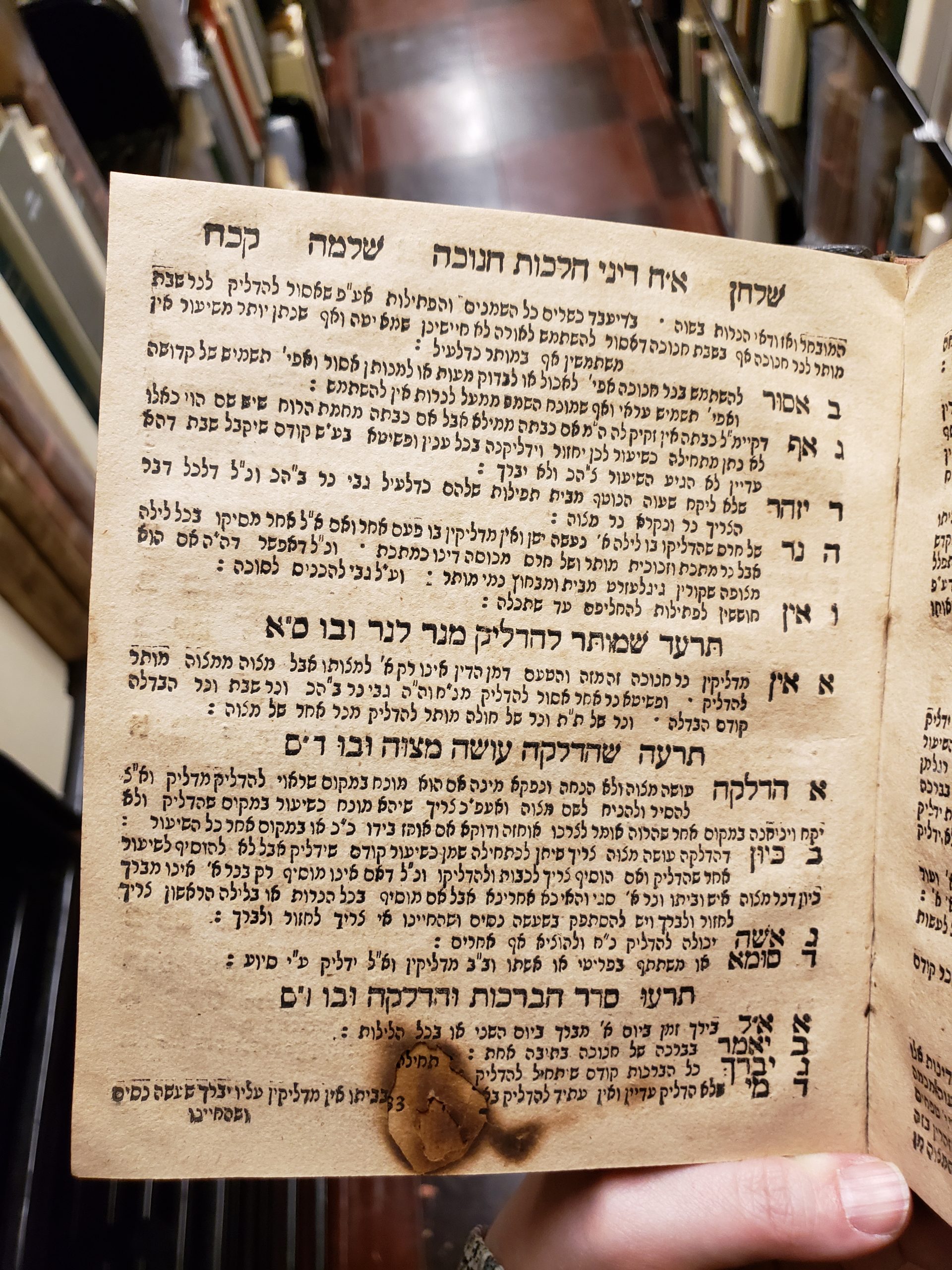
The library also preserves other fascinating texts from the same period, detailing the specific rituals and laws surrounding the lighting of the menorah. These texts are a testament to the care with which traditions were observed and recorded. One particularly intriguing volume even bears a singed hole—likely the result of a mishap by a reader consulting the book while lighting Hanukkah candles! Such artifacts provide a tangible connection to the lived experiences of those who celebrated Hanukkah centuries ago, highlighting the enduring vibrancy of this cherished festival.
A toast to the year ahead
As we look toward 2025, we can take inspiration from these two Columbians, as well as these extraordinary treasures in Columbia’s libraries. In their unique ways, they illuminate the power of creativity, kindness, and wonder—values which remain as relevant to our alma mater’s mission as they are to the holiday season.
From all of us at the Stand Columbia Society, warm wishes for a joyful holiday and a brilliant New Year. Thank you for being part of our community—because of you, we stand stronger together.
News Roundup
– December 20, 2024. Inside Higher Ed reports that Congress released its staff report on anti-semitism that lambasted higher education leaders for its failure to protect minority students on campuses. “Universities must restore academic rigor and stop their programs from being platforms for intellectually bankrupt radicalization and indoctrination, including the perpetuation of antisemitic falsehoods,” the report reads. Republicans repeatedly threatened to stop funding for universities that fail to act from a wide range of federal programs, including the National Institutes of Health (NIH). Federal law generally prevents recipients of taxpayer funds from tolerating discrimination and Representative Jason Smith, a Missouri Republican and chair of the Ways and Means Committee, expects to use tax policy and funding to restrict funding from universities that “have ignored or even condoned intimidation, harassment, and violence.’” Columbia features prominently in the report.
– December 19, 2024. In an op-ed in the New York post, Princeton sophomore Maximillian Meyer argues that elite universities are wrestling with a crisis of morality as numerous students and faculty seem to support the actions of Luigi Mangione who killed UnitedHealthcare CEO Brian Thompson in cold blood. At “Princeton, a poll of nearly 1,500 students on the Fizz social network revealed that 25% found Mangione’s action ‘completely justified,’ with another 22% saying Thompson’s death was ‘deserved.’ Only 13% managed to say the killer was purely ‘in the wrong.’” Increasingly amongst certain segments of the Ivory Tower, violence is increasingly acceptable against those that you disagree with. While this justification and acceptance of violence have started with some of the pro-Palestinian groups, it now seems to extend across various ideological faultlines.
– December 17, 2024. THe New York Times reports of a lawsuit aimed at MIT, Georgetown, Penn, and multiple other elite universities around admissions. The suit alleges these schools admit students based on significant donations or the likelihood of future generosity. These admissions cases are treated with special euphemisms – the “President’s List” at Georgetown or B.S.I. (“bona fide special interest”) at Penn.
– December 16, 2024. The University of Michigan announces it will establish an Institute for Civil Discourse at the University of Michigan to attract scholars and from differing points on the political spectrum. “We learn by confronting different arguments and different perspectives. Michigan is the place to do this — to show our community and nation that civil discourse is not just possible, it is the very best way to learn and to solve problems. It is fundamental to our democracy,” said President Santa J. Ono. The Michigan regents are creating a systemic series of steps to support “Principles on Diversity of Thought and Freedom of Expression”.
– December 14, 2024. The New York Times reports that as college campuses across the U.S. are becoming battlegrounds for intense debates over the Israel–Hamas conflict, universities are trying new tacks to respond. With a surge of pro-Palestinian protests, students are calling for divestment and pushing universities to take a stand. Many universities are responding with a back-to-basics approach, teaching students how to once again have a constructive, civil conversation. Columbia is highlighted for our “listening tables”, where Interim President Armstrong has also participated.