
In a pivotal development, the University Judicial Board (UJB) has finally come to life. The UJB is a panel of faculty, students, and administrators that is completely separate from and independent of Columbia’s administration, whose members are appointed by the University Senate’s Executive Committee. This body, responsible for adjudicating protest-related discipline at Columbia University, has begun disciplinary hearings this week for over 40 protestors involved in the spring encampments and Hamilton Hall occupation. This revelation comes from Columbia University Apartheid Divest (CUAD), which launched a campaign demanding amnesty for the protestors. Notably, the members of the UJB, once publicly listed, have now been kept confidential, adding a layer of intrigue to this process.
CUAD has identified the five-member panel handling the cases as:
- Senior HR Business Partner Sony Thornton
- Hosack Professor of Molecular Pharmacology Robert S. Kass
- Parker Professor of Comparative Law Katharina Pistor
- An undergraduate student
- A law student
Of these five, Professor Pistor has expressed public support for the encampments, which would likely have been disqualifying if the UJB were a real jury.
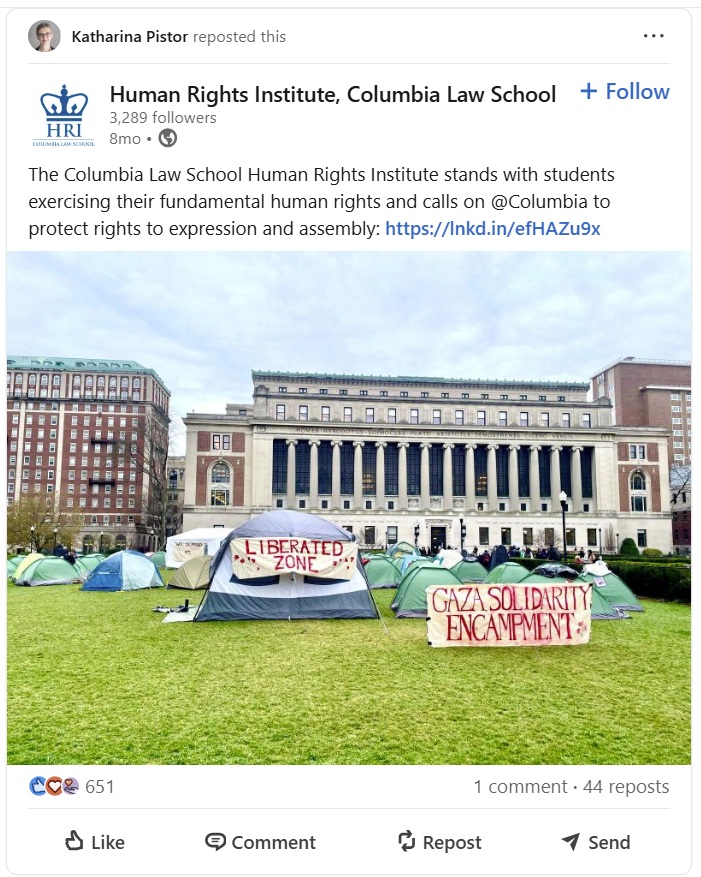
(Fun aside: Professor Kass holds the chair named after Dr. David Hosack, an early benefactor of Columbia. Hosack gifted his botanical garden to Columbia, which was near the site of our midtown campus in the 19th century and today is Rockefeller Center. Columbia finally sold the Rockefeller Center land for $400 million in 1985, which forms the foundation of our endowment. More notoriously, Hosack was the physician present at the Hamilton-Burr duel in 1804 and was sadly unable to save Hamilton’s life.)
The UJB’s renewed activity invites reflection on Columbia’s historical handling of student discipline—a track record rife with failures, leniency, and inconsistent enforcement.
A Brief History of the Rules of University Conduct
Columbia’s disciplinary framework for protests and demonstrations, the Rules of University Conduct, was formally promulgated on June 4, 1973. Initially, it resembled a formal judicial system, with cases first heard by school-specific Divisional Boards of Inquiry (DBI) and appealed to the University Judicial Board. Early processes included legalistic elements such as references to judges, lawyers filing briefs, formal arguments, cross-examination, and appeals. They also appeared to be open “trials”—as this Spectator photo shows a courtroom-like setup with dozens of spectators—in stark contrast to the secret Star Chamber tribunals of today. The University’s General Counsel reflected on the initial setup more than a decade later: “Those rules were terrible. They were poorly drafted, especially the procedural part, which was ridiculously legalistic.”
So far as we can tell, the Rules of University Conduct’s formal adjudicatory processes were only invoked five times in the University’s history. Here’s what happened in each.
Take One – March 1974
Five students went before the Divisional Board of Inquiry for disrupting a University Senate meeting. The members of the DBI then refused to serve in their roles, as they objected to the setup, which they found confusing, illegitimate, and lacking in due process. Outcome: nothing, as the process completely collapsed.
Take Two – December 1974
Another student who disrupted a University Senate meeting was brought before another Divisional Board of Inquiry, which promptly escalated into a physical brawl. Proceedings were halted. Outcome: physical brawl, after which proceedings were halted after the accused student withdrew from Columbia.
These failures prompted reforms. By 1982, external legal professionals (Hearing Officers) supplanted these internal roles (for which Columbia often faced “severe difficulties” in finding anyone willing to serve), streamlining the process but effectively outsourcing discipline to outsiders.
South African Divestment – April 1985
This was the famous 21-day South African divestment blockade of Hamilton Hall. Over a hundred protestors were tried by Lewis Kaden (then a partner at Davis Polk and an adjunct at Columbia Law). Outcome: 54 were found guilty, 61 were acquitted. The key argument was that as Hamilton was still accessible via tunnel, the blockade wasn’t really a blockade. The penalty was one semester disciplinary probation. Twelve seniors had their diplomas withheld pending completion of the disciplinary process and were not permitted to graduate with their class
Racial Tensions on Campus – April 1987
On March 22, 1987, a racial confrontation between black and white students escalated into a physical fight. A group, Concerned Black Students at Columbia (CBSC) then papered the campus and New York City with “wanted posters” bearing the names and photographs of four white students demanding their expulsion—which bears an eerie resemblance to today. On April 21, 1987, protestors chained the doors of Hamilton. The next morning—citing a fear of exacerbating racial tensions—Michael Sovern had the NYPD come to campus and arrest over 90 students.
Disciplinary proceedings started promptly days later. The Hearing Officers were Alvin Hellerstein (then a partner and co-chair of litigation at Stroock) and Charlotte Fischman (then a partner at Kramer Levin). Outcome: the initial set of nine charges levied against over 40 students were whittled down to one relatively minor charge against 37 students (six graduating seniors had charges dismissed “on the grounds that even if the seniors were found to have violated Columbia regulations, the University could take no action against them”). The sanction was, again, one semester of disciplinary probation.
Audobon Ballroom Protest – December 1992
This was yet another Hamilton occupation in protest of Columbia taking over the Audobon Ballroom, where Malcolm X was assassinated. The protestors included Ben Jealous CC ’94, who would later become President of the NAACP and Executive Director of the Sierra Club. The Hearing Officer was Harold Tyler (previously a Federal judge, and Deputy Attorney General under Ford). Outcome: Judge Tyler found the accused guilty, levied a one-semester suspension, and then immediately urged the students to appeal his sentence. As far as we can tell, the sanctions were never applied because the students were either graduating or planning a gap semester anyway.
There have been other protests since, which did not result in the formal Rules processes being invoked. In 1996, students occupied Low, which led to police being called again. In 2007, we had another encampment on south lawn. In 2016, Low Library was occupied for a week. Despite threats to suspend them, the University ended up prescribing “alternative resolutions” where the students had to write letters of apology and resign from certain club leadership positions.
In 2015, the Rules were revised again. Here, the University Judicial Board became the court of first instance, replacing the external hearing officers, with a separate appeals board of three deans. Ironically, this is similar to the failed 1973 processes with the Divisional Boards of Inquiry.
What can we take away from this? Here are three sobering conclusions.
First, while members of the Columbia community may support the Rules being enforced, nobody wants to do the actual “enforcing”. The University’s disciplinary history is marred by repeated failures, driven by the inherent social and political dynamics within academic circles. Few without other agendas want to be involved with these processes. Students are reluctant to punish their peers, and faculty often avoid disciplining students due to fear of social ostracism. As one faculty member previously involved with the UJB put it, “I still need to be able to go to lunch with my colleagues.”
Second, the administration has historically used the “fear of the Rules” to push students into informal settlements. That fear, however, has dissipated. In cases from 1996, 2007, and 2016, the formal disciplinary processes were threatened but never enacted. Students opted for informal resolutions under the belief that these would be more lenient. Yet, the historical record shows that formal Rules processes almost never led to significant consequences. The message that many would-be protestors take away now is: “Always demand the formal Rules of University Conduct, because that almost guarantees you’ll get off scot-free.” The lack of enforcement over time has fueled calls for amnesty, as few now see the Rules as a functional deterrent.
Third, myths about Columbia’s disciplinary history persist in campus culture. For example, claims that “Columbia has rarely disciplined students” overlook the fact that the administration, notwithstanding the dysfunctional Rules of University Conduct process, has disciplined misconduct many times through Dean’s Discipline. Similarly, the belief that “Columbia hasn’t called the police on campus since 1968” is false. Police have been summoned to break up protests in 1970, in 1972, in 1987, and in 1996. Every president since 1953, except Lee Bollinger and the current incumbent, has had the NYPD break up protests. Finally, assertions that “our disciplinary processes worked fine until they were subverted” ignore the reality that two out of five attempts to enforce the Rules failed entirely. The other three succeeded—albeit with light penalties—because the University “outsourced” the process to external legal professionals who adhered to strict timelines.
These conclusions leave us between two impossible extremes. The UJB (and its predecessor entities) have due process protections, but take months, and have historically universally failed to actually discipline protestors. It bears noting that the UJB now lacks many of the due process protections from the past—the extended timelines and the now-secret proceedings seem quite at odds with the Constitutional ideal of a “speedy and public trial.” Meanwhile, Dean’s Discipline does work, but lacks robust due process protections.
NYU, less than a month after the Bobst Library blockade, issued year-long suspensions to 11 students, precisely because they did not put them through a UJB-like proceeding. In contrast, eight months have passed since the Hamilton occupation, and no significant disciplinary actions have been taken. This occupation was also, as far as we can tell, materially different from the past “blockades” in that they involved significant property damage.
Our Prediction (and We Hope We Are Wrong)
First, the UJB will attempt to dismiss all charges on the grounds that there is “no evidence” that the occupiers actually occupied Hamilton Hall. They went in wearing masks and covered security cameras. When police arrested them, obviously names were made known to Columbia, but Manhattan DA Alvin Bragg dropped charges and asked records to be sealed with the understanding “that they will face internal disciplinary proceedings at Columbia.” Some lawyers are now arguing that because a state court has sealed the evidence (the arrest records and identities of the Hamilton occupiers) for criminal purposes and thus it is inadmissible in a state criminal proceeding, therefore Columbia’s internal discipline process can’t use that evidence either. Ergo, Columbia cannot proceed with internal disciplinary proceedings. This is, of course, circular and absurd.
Second, if the attempt to dismiss charges fails, then based on historical precedent, the UJB will likely grant amnesty to some of the student protestors, and find a subset guilty of “simple” violations—notwithstanding the property damage that made this occupation materially different from past incidents. At most, these individuals may face one semester of disciplinary probation—all decided behind closed doors in Star Chamber-like proceedings. The route to appeals is likely also closed off, as (1) findings of guilt or innocence cannot be appealed on the grounds of disagreement, and (2) the appeals board may only “affirm or reduce the sanction, but may not increase it.”
This is unacceptable. We need functioning institutions or, failing that, institutional redesign which protects due process rights but actually disciplines. One question is whether the University Judicial Board can, in fact, be a “functioning institution”? Or will it fail, yet again, to hold offenders accountable, as it and its predecessors have done every time in our history? What is at stake is not just disciplining rulebreakers, but the very viability of our shared governance model. If our prediction comes true, and the UJB fails again, then “institutional redesign” may be the only choice left.
News Roundup
– January 11, 2025. The Times of Israel reported that a long-standing Columbia Law professor has left the university after her “discrimination against Israelis.” There had been a Title VI investigation launched against her regarding comments she made last year on Israeli students. In a “Democracy Now” January 2024 interview, Franke shared “concern” that she and others shared over a graduate program at Columbia University specifically for students from Israel. Her specific words were, “So many of those Israeli students, who then come to the Columbia campus, are coming right out of their military service. They’ve been known to harass Palestinian and other students on our campus.” Columbia Law Dean Daniel Abebe wrote in an email to Columbia faculty that Franke was “accelerating her planned retirement” and that her last day would be Friday. She has been at the school since 2000. Franke replied to his email, sharing she felt it “reflects significant inaccuracies” and includes “misinformation.” Franke’s full statement is here, which also links to statements of support from others during the investigation.
– January 9, 2025. Inside Higher Ed reported that a multi-year effort to shift how colleges respond to allegations of sexual discrimination and harassment and to “expand protections for transgender students” is nullified after a ruling from a federal judge that the Biden administration’s edits to Title IX of the Education Amendments of 1972 is not legal. This new legislation would make the act of using the “wrong pronouns” for a student legally viewed as harassment. A judge appointed by George W. Bush called this suggestion one that “offends the First Amendment.” The suggested changes had already been paused in 26 states and at many colleges due to multiple lawsuits filed by 26 Republican attorneys general across the states. The ruling from this week was the first ruling to come from those cases and was from a lawsuit filed by West Virginia, Kentucky, Ohio, Tennessee, Virginia, and Indiana.
– January 8, 2025. The Indypendent reported that NYU has suspended 11 students for one year because of their protests against the “Gaza Genocide.” On December 11, 2024, NYU faculty and students distributed flyers and banners around Bobst Library while over a dozen more people sat down in the administrative area. The protesters were asking for a meeting with school administrators who had, the previous spring, said they would “disclose the university’s endowment, including all its investments in weapons manufacturers and ties to Israel and companies that profit off its occupation of Palestine.” The protest and sit-in was put on by the student group called Shut It Down NYU, whose goal is to oppose what they perceive as the connections between imperialism and NYU. The suspension was given for the reason of “coordinated and collective disruptive action.”
– January 7, 2025. The Boston Globe wrote this week about how some Israeli students on American university campuses are being shunned by their fellow students for political reasons. A now-senior at Harvard describes how some peers would ignore him when he first started at the school because he had participated in the Israeli army. Apparently, he and his Israeli compatriots were “backlisted” from final clubs and after October 7, some friends refused to engage with him in certain ways in public for fear of retaliation. The Globe recommends: “To reach the root of the problem, however, schools need a culture shift. That means hiring faculty and admitting students who are willing to listen to and engage with individuals who are different from themselves. It means having diverse voices on campus that reflect the views students will encounter when they leave college. Faculty must model what it means to engage constructively across viewpoints.”
– January 6, 2025. The Free Press reported that there was a recent exhibition that showed off the plan and the tools responsible for the Hamilton Hall break-in. One Jewish student who went to the exhibition out of curiosity and concern called it “a museum of terror.” On the first floor of the two-story exhibition was a display of the Columbia Board of Trustees, “exposing” their “crimes against the Palestinian people,” including actions such as speaking at AIPAC and being on the board of the NYPD foundation. In the middle of the room was a pool table littered with construction tools like ropes, wire cutters, hammers, and wrenches, which had been used by the anti-Israeli protesters in their take-over of Hamilton Hall in April 2024. Right near the tools was a sign that read, “DO NOT GET YOUR FINGERPRINTS ON THESE!!”