
This coming Wednesday, May 21, 2025, over 16,000 graduands (the term for students who have completed their exams but have not yet received their degrees) will graduate from Columbia University in its 271st academic year. It’s a real moment of joy for the graduates and for the over 400,000 alumni waiting to welcome them.
We thought we’d take a moment to look into what Columbia’s commencement looked like over the years. Thank you to the University Archives, Google Books, and Columbia’s clerk at the turn of the 20th century, John B. Pine, a meticulous record keeper.
Commencement in 1762
In the summer of 1762, Commencement at King’s College was a solemn and intimate affair, held not on leafy Morningside Heights (which wouldn’t exist for another 130 years), but at the now-lost St. George’s Chapel on Beekman Street in Lower Manhattan. King’s College had just opened its first building at Park Place, and the commencement exercises began with a 5-block academic procession passing through what was then and today City Hall Park.
There were no jokes, no inflatable hammers, no obsequious addresses (“I beg you, Madam President, to grant them their degrees!”) There was, however, reverence, precision, and a great deal of Latin. Furthermore, they were called commencement exercises because they were, quite literally, academic exercises. That is, graduands had to demonstrate what they had learned through orations and debates.
Here is a reconstruction of the order of Commencement exercises taken from the writings of the Reverend Dr. Samuel Johnson, our first President, or Praeses.
- Opening prayers
- Welcome address (in Latin) by the President
- Bachelor’s degree academic exercises
- (In Latin) Salutatorian’s address
- (In English) Students were paired up and debated in more forensico (forensic style) a philosophical subject, moderated by the President. Yes, you had to sit through all of these.
- Mendacia quaedam sunt licita. [Some lies are permissible.]
- Gravitatio universa fit mechanica. [Universal gravitation is mechanistic.] Here, an observer recorded: “Mr. Treadwell, in a clear and concise manner, demonstrated the revolution of the earth round the sun, both from astronomical observations, and the theory of gravity, and defended the thesis against Mr. Cutting and Mr. Wetmore, a candidate for the Degree of Master of Arts.”
- Datur vacuum in Natura. [There is a vacuum in nature.]
- Sine Libero arbitrio non potest esse nec virtus nec vitium. [Without free will there can be neither virtue nor vice.]
- Animae Immortalitas patet ex Lumine Rationis. [The immortality of the soul is manifest by the light of reason.]
- Obligatio perfecta moralis penedet ex voluntate Dei. [Perfect moral obligation depends upon the will of God.]
- Master’s degree academic exercises (similar to Bachelor’s degree, but presumably on more difficult subjects.)
- Conferring of the degrees
- The President then turns to the Governors of King’s College, and asks “Viri admodum generosi, ut hi juvenes ad Baccalaureatus in Artibus Gradum , Atque ut hi viri ad Magistratus in Artibus Gradum, admittantur?” (“Is it your pleasure, gentlemen, that these youths may be admitted to the degree of Bachelor of Arts, and that these men may be admitted to the degree of Master of Arts?”
- Having received their consent, the President turns to the graduand, places both his and the graduand’s hands on a Hebrew psalter, and says “Ego ex authoritate hujus Academiae , Regio Diplomate constitute, admitto Te, ad Baccalaureatus ( Magistratus ) in Artibus Gradum.” (“I, by the authority of this academy, constituted by Royal Charter, admit you to the degree of Bachelor (or Master) of Arts.”) At this moment, the graduand becomes a graduate. On a side note, as recounted by our own Jewish studies librarian Michelle Margolis, Samuel Johnson was famously literate in Hebrew, wrote a Hebrew grammar book, and encouraged its study (sadly, without much success) in the early days of King’s College, where it was a mandatory part of the fourth year curriculum.
- (In Latin) Valedictorian’s address
- (In English) President’s closing address. This might have been the origin of the tradition where Columbia’s commencement address is always given by the President, and not by an outside speaker.
- Closing prayers
There were no diplomas handed out that day. Those came later, in 1763, under Johnson’s successor Myles Cooper (you can see John Jay’s diploma here). The centerpiece of the ritual was not the scroll but the gesture, that of Johnson and the graduate holding Johnson’s Hebrew Psalter (printed in 1685) together, symbolically marking a transmission of learning. That psalter has, since 1953, has been in the collection of University Archives.

A decade later, on the eve of the American Revolution, the exercises were similar, including disputations on “cheerfulness”, “love”, “delicacy”, and “pneumatics.”
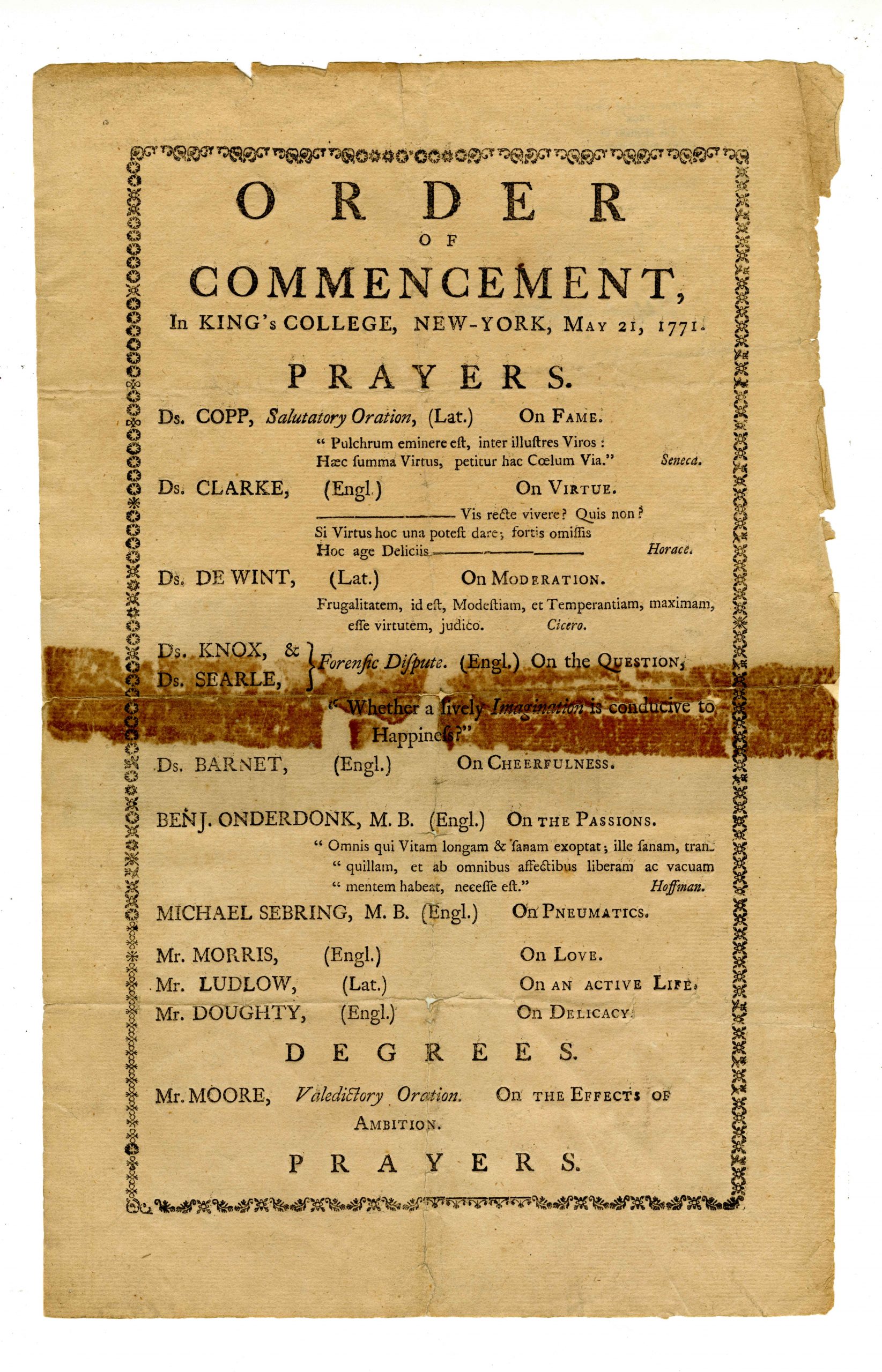

When the College reopened after the Revolution, for its first commencement in 1789 as Columbia College, President George Washington, Vice President John Adams, both houses of Congress, and the Governor of New York all attended, as New York was the seat of government.
This was Columbia’s first blueprint for commencement: intimate, rigorous, and radiant with purpose. The theater was modest, but the roots of the traditions that have come to our present day were already settled.
Commencement in 1908-1919
There is a wonderful volume on Google Books that records the commencement programs from 1908-1919. You can find it here.
By the early 20th century, Columbia’s Commencement had transformed from a cloistered ecclesiastical ritual into a weeklong civic celebration. The ceremony was no longer held in downtown churches, but in the gymnasium in University Hall (University Hall was supplanted by Uris Hall in the 1960s; Commencement began being held on Low Steps starting in 1926) as befitting Columbia’s evolution into modern research university.
Commencement week was packed with ceremonies, exhibitions, performances, and social gatherings. Graduating students, their families, and members of the public were invited to attend a dense calendar of celebrations that reflected the diversity of Columbia’s schools and its growing urban prominence.
There was a “Tree Day” at Barnard. There was a “senior dance.” There was an architectural exhibit. A baseball game of the senior class vs. the faculty in South Field (where Lou Gehrig played). A “lawn party” at Teachers College. Also something called an “amateur circus.” There was an “alumni beefsteak dinner” (which was a specific thing in 19th and early 20th century New York.) Of course, “various Greek letter fraternities will provide entertainment for members and guests during the afternoon and evening,” of which nothing further was said. It appears to be both a reunion and a commencement as there were alumni receptions and dinners. In short, it looked like a lot of fun.

Here is the Commencement program:
- Opening prayers
- Commencement address by the President of the University, then Nicholas Murray Butler
- Conferring of the various degrees, which in 1918 included:
- Bachelor of Arts and Bachelor of Science (this included “Bachelor of Arts certificate for academic record and national service” which were given to active servicemembers as we were amidst World War I)
- Bachelor of Laws
- Doctor of Medicine
- Engineer of Mines, Metallurgical Engineer, Civil Engineer, Electrical Engineer, Mechanical Engineer, Chemical Engineer, and Chemist
- Bachelor of Science in Education and Bachelor of Science in Practical Arts (this section was overwhelmingly women)
- Diplomas in Education and Practical Arts (also overwhelmingly women)
- Architecture
- Pharmaceutical Chemist
- Bachelor of Literature in Journalism
- Bachelor of Science in Business
- Master of Arts, Master of Laws, and Master of Science
- Doctor of Philosophy (this section listed their dissertation titles)
- Conferring of honorary degrees
- Hymn: “My Country, Tis of Thee”
- Closing benediction
The ceremony was scored to music: at the time, Elgar’s “Pomp and Circumstance” was not yet the graduation march, so we had Wagner (Tannhauser) for the processional, and Mendelssohn for the recessional. Following the ceremony, faculty and trustees hosted a formal luncheon for prize recipients and honorands. Meanwhile, graduates scattered across campus for class photographs, receptions, and goodbyes. The University quite courteously made sure “the swimming pool and shower baths will be open for the use of Alumni from four till seven o’clock on Commencement Day.”
But it looked much more like today. Individual schools and faculties conferred degrees to their students. No more metaphysical disputations in Latin. By this era, Commencement was no longer a tight circle of theologians and logicians. It was a civic ritual, a showcase of this nation’s promise. The graduates were lawyers, engineers, educators, nurses, poets, and public servants. The speeches now emphasized democracy, duty, and progress. But Commencement was still about stepping into the world with purpose, responsibility, and pride.
Congratulations to the Class of 2025
To Columbia’s Class of 2025: what a legacy you join.
You graduate not from King’s College of 1762 nor the Columbia of 1918, but from a university that traces its rich legacy to both ritual and reinvention. Your journey has taken place in a world more complex than your predecessors, but you also walk forward with a degree and the question: what will you do with it?
Whether your path takes you toward research, service, commerce, arms, law, or creativity, may your Columbia education be more than a credential. May you be, as Columbia’s first President Samuel Johnson urged in 1762, “great blessings and ornaments to [your] country in [your] several ages and generations.”
With pride and admiration, the Stand Columbia Society salutes the Class of 2025. Congratulations. You’ve earned this. You carry our legacy. And now, you extend it.
News Roundup
– May 17, 2025. The NYT reports that Education Secretary Linda McMahon has called for renewed talks with Harvard, while doubling down on the Trump administration’s hardline stance. Despite offering to reopen dialogue, McMahon made clear that federal pressure will continue unless Harvard aligns more closely with administration demands on admissions, curriculum, and governance. The government has already pulled $2.7B in funding, and a new DOJ investigation under the False Claims Act looms. McMahon praised recent faculty dismissals and protest crackdowns as signs of compliance but warned that billions more remain at stake. “The administration’s priorities have not changed,” she said.
– May 17, 2025. The NY Daily News reports that as graduation season begins, New York-area universities are cracking down on disruptive protest. NYU withheld a student’s diploma after he began condemning Israel during his commencement speech (which was not in his advance remarks), while other schools are banning decorated caps, scaling back ceremonies, or canceling student speakers altogether. Columbia has warned students that disruptions will trigger disciplinary action, and CUNY schools have drastically reduced graduation programming.
– May 16, 2025. The NYT reports that NASA scientists at Columbia’s Goddard Institute—located above iconic Tom’s Restaurant of Seinfeld fame—have been ordered to vacate by month’s end as part of the Trump administration’s sweeping review of federal leases. But the move, targeting a climate research hub with historic contributions, appears more symbolic than cost-saving: the $3 million lease remains in effect, with rent still owed. Columbia has pledged to support displaced staff, while researchers call the abrupt shutdown disruptive and senseless. The closure follows broader cuts to climate and equity-focused science, deepening concerns about political targeting of academic research.
– May 15. 2025. The NYT reports that the Trump administration has escalated its clash with Harvard by launching a Justice Department investigation under the False Claims Act, a law typically used against government contractors accused of fraud. The False Claims Act is a significant escalation as it permits private parties to whistleblower-style lawsuits against government contractors and win a 15-30% payout if their claims proven true. Most telling was this quote, “But behind closed doors, several senior officials at Harvard and on its top governing board have acknowledged they are in an untenable crisis. Even if Harvard quickly wins in court, they have determined, the school will still face wide-ranging funding problems and continuing investigations by the administration. Some university officials even fear that the range of civil investigations could turn into full-blown criminal inquiries.”
– May 15, 2025. The Boston Globe reports that a federal judge has ruled that Mohsen Mahdawi will be allowed to leave Vermont to attend his Columbia graduation next week, “returning to the campus where his participation in pro-Palestinian protests has put him at risk of deportation.” After a two week detainment, his release was commanded by US District Court Judge Geoffrey Crawford with a few stipulations, including that he stay in Vermont while litigation unfolds. He asked for and was granted special permission to travel to New York for ten days to meet with attorneys and attend his graduation, among other plans.
– May 14, 2025. Fox reports that the mood at Columbia has been more sober this week after the previous protest was shut down and 80 arrests were made. Of those, at least 50 were supposedly Columbia students. It’s been made clear that Columbia is keeping students on a tighter leash. Student Harmony Cruz Bustamante said the day after the campus arrests, “It was very scary. I think the energy after last night, the dynamic has shifted. There’s just a collective understanding now on campus that we don’t talk about certain things because of fears of getting detained or questioned by the authorities. So it was very scary last night because the university really revealed themselves in that they… really don’t have our interests at heart. And I think that was seen through the viciousness that a lot of the public safety officers and NYPD had.” A lot of international students (who are 38% of the school) declined to comment to Fox, fearing retribution from the administration in the form of deportation or visa revocation.
– May 14, 2025. The NYT ran a piece this week about how other countries are swooping in to try to lure away the American researchers who’ve lost funding under the Trump administration, perceiving a “once-in-a-century brain gain opportunity.” Usually the States have been the ones who entice global scholars, but certain countries are hopeful that the tides may be temporarily turning for “top researchers, scientists and academics.” Last year, the US spent almost $1 trillion on research and development alone. For long-term research, the government footed the bill for approximately 40% of it. Last week, the EU stated it would “spend an additional 500 million euros, or $556 million, over the next two years to ‘make Europe a magnet for researchers.’” It remains to be seen whether the private sector and/or an international move proves more appealing to elite scientists. As the Times notes, “salaries tend to be much lower in Europe.”
– May 13, 2025. In an op-ed in the WSJ, columnist Jason L. Riley argues that elite universities like Columbia and Harvard have abandoned education for ideological activism, and are now facing the consequences. From aggressive campus protests to the federal government’s sweeping investigations into hiring and grant practices, Riley traces how political bias and perceived indoctrination have brought Ivy League institutions into direct conflict with the Trump administration. The piece critiques what it calls the decline of intellectual diversity and warns of escalating political and financial repercussions for higher education.
– May 13, 2025. The NYT reports that the current administration has cut $450 million more in Harvard grants, although no new “accusations” have come to light against the school. Rather, the government has stated that Harvard hasnt taken care of “pervasive race discrimination and antisemitic harassment” on campus. The government task force said that, “There is a dark problem on Harvard’s campus, and by prioritizing appeasement over accountability, institutional leaders have forfeited the school’s claim to taxpayer support.” It is still unclear which grants are being slashed, but apparently there were eight government agencies included in the process of taking away the extra $450 million on top of the $2.2 billion already paused.
– May 13, 2025. The Spectator ran an op-ed this week from its editors about how Barnard and Columbia are failing their student press. Apparently, during the police presence last week, efforts from student reporters and photographers were curtailed or blocked by Public Safety and the NYPD. One student photographer recounts that a Public Safety officer “pushed her back by her head on two occasions while restraining her with an arm against her neck, effectively choking her. In fact, the officer gripped her arms so tightly she bruised.” Last week, they also wrote a letter from the editors asking Shipman to speak to the student press, so we’ll see what happens.
– May 13, 2025. The Economist ran a piece this week by Richard Hanania, “lamenting” Trump’s “attack on universities,” where he argues that “one version of thought control is being replaced with another that is worse.” He asserts that “rather than sticking to the principles of colour blindness, merit and individual liberty that I believe in, the Trump administration seeks to implement its own version of thought control and federal-government overreach.” He calls some of the demands Trump made to Harvard “radical and unprecedented,” including demanding the elimination of “entire fields of study.” Calling out the hypocrisy, he writes, “At the same time as the administration accuses Harvard of being ideologically captured, it demands new ideological screening of foreign students, so as not to admit antisemites, supporters of terrorism or “students hostile to the American values and institutions inscribed in the US Constitution and Declaration of Independence”. He thinks Harvard is likely to win its lawsuit against the federal government, given what he sees as the utter lack of precedent.
– May 12, 2025. The NYT reports that in a letter to Education Secretary Linda McMahon, Harvard President Alan Garber struck a conciliatory tone, expressing agreement with Trump administration goals like increasing intellectual diversity and combating antisemitism—while firmly rejecting what he called unconstitutional government overreach. As the administration moves to freeze over $2 billion in federal funding and block new grants, Garber argued that Harvard is nonpartisan and committed to free inquiry. The letter signals Harvard’s attempt to de-escalate tensions without conceding its core academic freedoms.
– May 12, 2025. A father and son team have filed a lawsuit against four universities: the University of California, the University of Washington, the University of Michigan, and Cornell “for discriminating against Asian Americans in their admissions.” They are representing themselves in court. The son, Stanley Zhong, was “hired by Google for a PhD-level position after being rejected by 16 colleges for undergraduate admission. His college application story was cited in a congressional hearing in 2023.” the universities have begun to retain top level counsel to respond to this suit, including the University of California hiring WilmerHale, the firm which Harvard used in the Students for Fair Admissions lawsuit.
– May 11, 2025. The site Visual Capitalist released an infographic this week on the funding behind American universities.
– May 9, 2025. WE WIN!!! Columbia baseball clinched its second consecutive Ivy League title with a commanding 19–1 victory over Harvard on May 4, 2025. The Lions’ offense erupted for 19 hits, including standout performances from Jack Kail and Griffin Palfrey, each driving in three runs. Pitcher Jagger Edwards delivered five shutout innings, securing the win. This triumph marks Columbia’s 17th Ivy League championship and the eighth under head coach Brett Boretti, who also celebrated his 400th career victory with the program. Truly the heirs of Lou Gehrig.